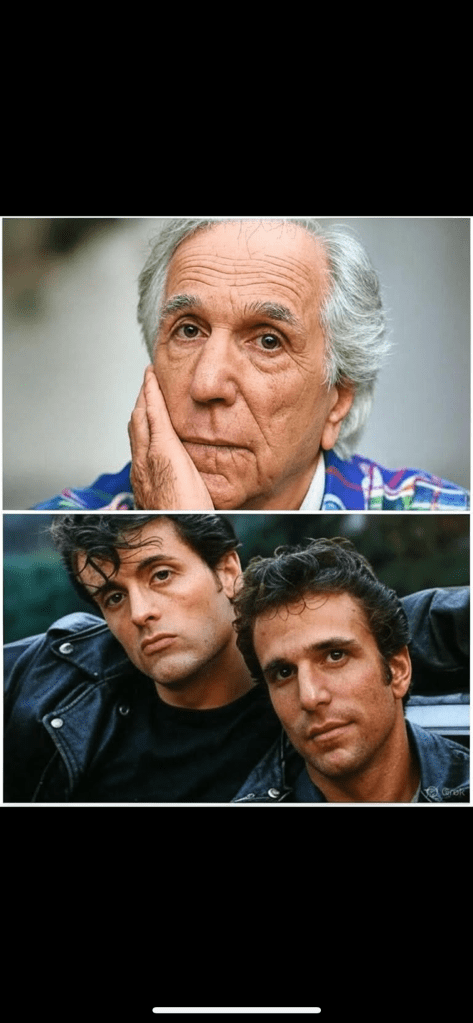
In 1974, when Sylvester Stallone was on the brink of giving up, barely scraping by and carrying a tattered script that nobody wanted, Henry Winkler stepped in—and quietly changed everything. Stallone had just been turned down for yet another minor TV role when Winkler, then a breakout star thanks to Happy Days, noticed him sitting alone outside a casting office. Stallone looked exhausted, defeated, with a worn folder under his arm. But when he started talking about the script he’d written, something changed. Winkler later said, “There was a light in his eyes—he believed in that story more than anything else.”
That story was Rocky. Stallone had written it in just a few days after watching the gritty 1975 Ali-Wepner fight, pouring all his frustrations and dreams into the screenplay. He had pitched it all over town, but studios weren’t interested—unless they could recast the lead with someone like Ryan O’Neal. Stallone refused, insisting he had to play the role. That decision left him broke and out of options.
Winkler, moved by Stallone’s passion and the raw honesty of the script, read it that same night. The next day, he called his agent, Jackie Lewis, and told her, “This guy has something. It’s rough, but it’s real. He’s real.” Lewis agreed to meet Stallone, took him on as a client, and began shopping the script around seriously. That move eventually led to producers Irwin Winkler and Robert Chartoff, who saw the film’s potential. United Artists showed interest—but only with a big-name actor. Again, Stallone refused. Eventually, the producers convinced the studio to take a risk, with a reduced budget and Stallone in the lead.
Stallone later told Variety, “Henry was the first person in Hollywood who didn’t just pat me on the back—he actually did something. He got me in the door. Without him, Rocky doesn’t happen.”
Henry Winkler never made a big deal of it. He didn’t seek attention or take credit for launching one of the most successful franchises in film history. But the people close to him knew. During a 1988 appearance on The Arsenio Hall Show, Winkler mentioned Stallone briefly, saying, “I just thought the world needed to see what was inside that guy.” That quiet belief echoed louder than any headline.
Stallone never forgot. Years later, during press for Rocky Balboa, he said, “Henry didn’t just help me—he believed in me when there was absolutely no reason to.”
There’s another lesser-known moment that says everything about their bond. After Rocky took off in 1976 and scripts started flooding in, Stallone was offered a lead in The One and Only, a comedy about a brash professional wrestler. He passed—but told producers, “You should talk to Henry Winkler.” They listened. Winkler got the role. The film didn’t make waves, but the gesture stuck.
Reflecting on it years later, Winkler told Entertainment Weekly, “He didn’t owe me a thing. But he thought of me anyway. That means more than any award.”
What Henry Winkler did wasn’t about strategy or image. It was one actor recognizing the spark in another. No agenda. No credit-seeking. Just a quiet act of belief that helped launch a legacy—and left a mark on film history that few people even know about.
 Enjoy Weekend Guide